
Nervous System Overview: Understanding CNS and PNS Functions
The nervous system is a complicated network that regulates the body’s operations. In this Nervous System Overview, we’ll look at the two main components: the Central Nervous System (CNS) and the Peripheral Nervous System (PNS), and how they operate together to regulate critical bodily activities.
Functions of Brain
The brain is responsible for sensory input interpretation, muscle movement control, body temperature regulation, and higher cognitive activities such as memory, thinking, and decision-making.
Functions of Spinal Cord
The spinal cord serves as an important communication channel between the brain and the Peripheral Nervous System (PNS). It sends messages to control reflexes and movement. Damage to the spinal cord can significantly impair body control and nervous function.
Peripheral Nervous System (PNS) Functions
The Peripheral Nervous System refers to all the nerves outside the brain and spinal cord. Its primary job is to connect the CNS to the body’s limbs and organs, ensuring that brain signals reach muscles, skin, and internal organs. The PNS is organized into two main subsystems: the somatic nervous system and the autonomic nervous system.
Somatic Nervous System
The somatic nervous system regulates voluntary motions like walking and grasping objects by transmitting signals from the brain to the muscles. It also controls reflex actions, such as retreating from a hot surface.
Autonomic Nervous System
The autonomic nervous system regulates involuntary actions like heart rate, digestion, and breathing. It has two major branches:
- Sympathetic Nervous System: Activates the “fight or flight” response. This system prepares the body for stressful situations by increasing heart rate, dilating airways, and redirecting blood to muscles.
- Parasympathetic Nervous System: Promotes the “rest and digest” state. It helps the body relax, slows heart rate, stimulates digestion, and conserves energy during periods of rest.

Credit- https://copbela.org/
Summary of Nervous System Overview
In summary, the human nervous system has two major branches: the Central Nervous System (CNS), which includes the brain and spinal cord, and the Peripheral Nervous System (PNS), which connects the CNS to the rest of the body. The somatic nervous system regulates deliberate movements, whereas the autonomic nervous system governs involuntary actions. The autonomic system is further divided into two systems: sympathetic and parasympathetic, which govern stress and relaxation responses, respectively.

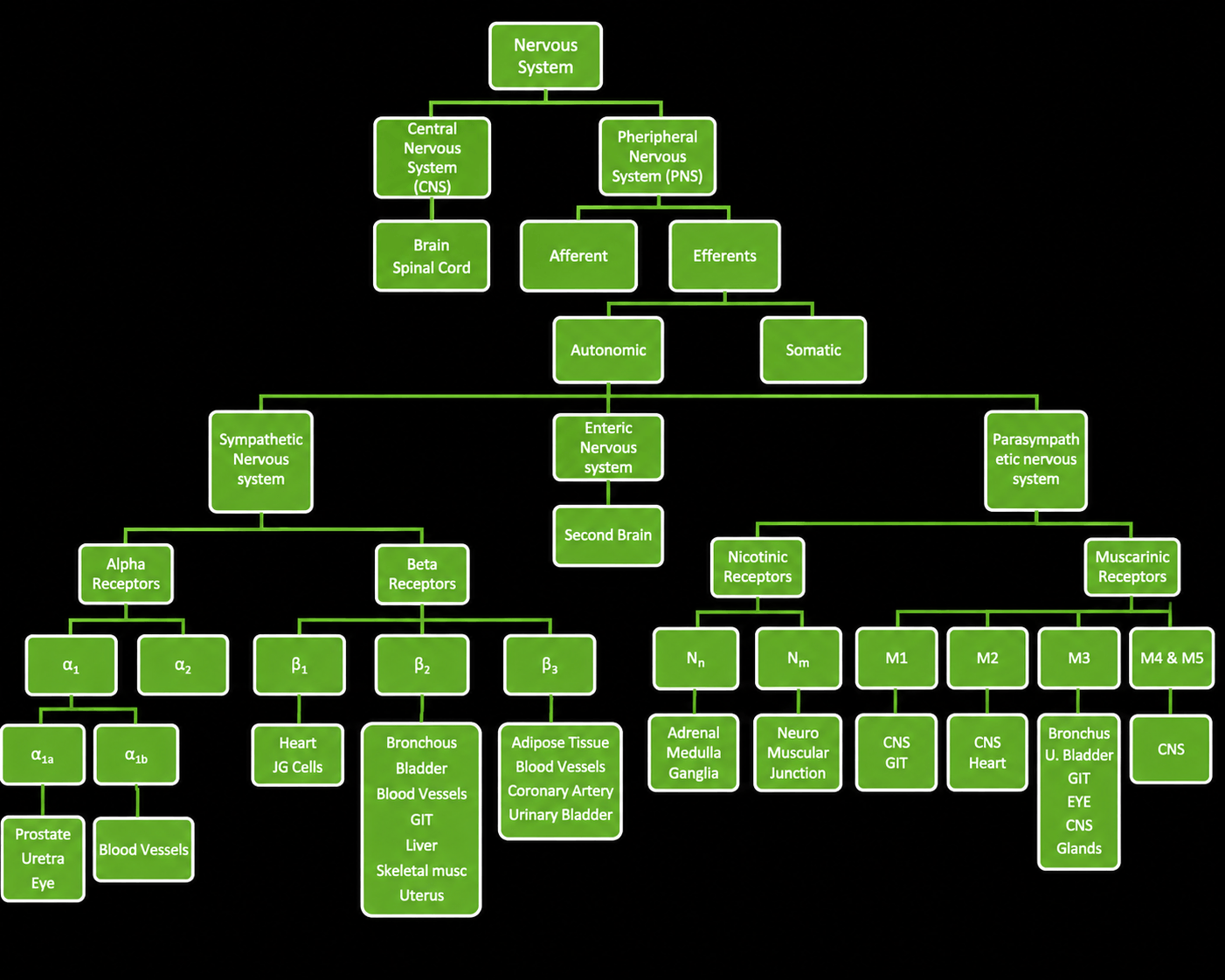
A comprehensive nervous system flowchart illustrating the Central Nervous System (CNS), Peripheral Nervous System (PNS), autonomic nervous system, sympathetic and parasympathetic divisions, nicotinic and muscarinic receptors, alpha and beta adrenergic receptors, and their target organs.
🧬 Common Receptors, Substrates and Drug Examples 💊
Receptor | Endogenous Substrate | Agonist Action | Drug Agonists | Antagonist Action | Drug Antagonists |
Muscarinic | Acetylcholine | ↑ SLUDD | Pilocarpine, Bethanechol | ↓ SLUDD | Atropine Oxybutynin |
Nicotinic | Acetylcholine | ↑ HR, BP | Nicotine | Neuromuscular blockade | Neuromuscular blockers (e.g., Rocuronium) |
Alpha-1 | Epinephrine, Norepinephrine | Smooth muscle vasoconstriction, ↑ BP | Phenylephrine, Dopamine (dose-dependent) | Smooth muscle vasodilation, ↓ BP | Alpha-1 blockers (e.g., Doxazosin, Carvedilol, Phentolamine) |
Alpha-2 | Epinephrine, Norepinephrine | ↓ Release of epinephrine, norepinephrine, ↓ BP, HR | Clonidine, Brimonidine | ↑ BP, HR | Ergot alkaloids, Yohimbine |
Beta-1 | Epinephrine, Norepinephrine | ↑ Myocardial contractility, CO, HR | Dobutamine, Isoproterenol | ↓ CO, HR | Beta-1 blockers (e.g., Metoprolol, Propranolol, Carvedilol) |
Beta-2 | Epinephrine | Bronchodilation | Albuterol, Terbutaline, Isoproterenol | Bronchoconstriction | Non-selective beta-blockers (e.g., Propranolol, Carvedilol) |
Dopamine | Dopamine | Renal, cardiac, CNS effects | Levodopa, Pramipexole | Many effects on renal, cardiac, CNS | First-gen antipsychotics (e.g., Haloperidol), Metoclopramide |
Serotonin | Serotonin | Platelet, GI, psychiatric effects | Triptans (e.g., Sumatriptan) | Many effects on platelet, GI, psychiatric | Ondansetron, Second-gen antipsychotics (e.g., Quetiapine) |
Nervous System FAQs
What is the nervous system?
The nervous system is the body’s main communication and control system. It allows the brain, spinal cord, and nerves to send and receive information throughout the body.
It helps humans:
- Think and learn
- Move muscles
- Feel sensations such as pain, temperature, and touch
- Control automatic functions such as heartbeat and digestion
- Respond to changes in the environment
The nervous system works through specialised cells called neurons, which transmit electrical impulses and chemical signals.
It also works closely with the endocrine system to maintain homeostasis, which means keeping the body’s internal environment stable.
Classification of the nervous system
The nervous system is divided into two major parts:
1. Central Nervous System (CNS)
The central nervous system consists of:
- Brain
- Spinal cord
The CNS acts as the processing centre of the body. It receives information, interprets signals, and coordinates responses.
2. Peripheral Nervous System (PNS)
The peripheral nervous system includes all nerves outside the brain and spinal cord.
It connects the CNS with:
- Muscles
- Skin
- Organs
- Sensory receptors
The peripheral nervous system is further divided into:
Somatic nervous system
Controls voluntary actions such as:
- Walking
- Writing
- Moving muscles
It also carries sensory information such as:
- Touch
- Pain
- Temperature
Autonomic nervous system
Controls involuntary functions including:
- Heart rate
- Blood pressure
- Digestion
- Sweating
- Breathing patterns
The autonomic nervous system includes:
- Sympathetic nervous system
- Parasympathetic nervous system
- Enteric nervous system
What is a central nervous system?
The central nervous system (CNS) is the main control centre of the human body. It consists of the brain and spinal cord.
The CNS processes information received from the body and produces appropriate responses.
Functions of the CNS include:
- Processing sensory information
- Controlling movement
- Regulating emotions and behaviour
- Supporting learning and memory
- Coordinating reflex actions
The spinal cord acts as a communication pathway between the brain and the rest of the body. It also controls rapid reflex responses without requiring conscious thought.
What does the PNS do?
The peripheral nervous system (PNS) connects the central nervous system to the rest of the body.
Its main role is communication between the brain, spinal cord, and body tissues.
The PNS performs two major functions:
Sensory function
Sensory nerves carry information from the body to the CNS.
Examples:
- Pain
- Temperature
- Pressure
- Touch
- Body position
Motor function
Motor nerves carry instructions from the CNS to muscles and organs.
This allows the body to:
- Move
- Produce gland secretions
- Control organ activity
The PNS also contains the autonomic nervous system, which regulates automatic body processes.
The circulatory system the nervous system and the digestive system are all examples of what?
The circulatory system, nervous system, and digestive system are examples of organ systems.
An organ system is a group of organs that work together to perform a specific function.
Examples:
| Organ System | Main Function |
| Nervous system | Communication and control |
| Circulatory system | Transport of oxygen, nutrients, and waste products |
| Digestive system | Digestion and nutrient absorption |
| Respiratory system | Oxygen exchange |
| Endocrine system | Hormone regulation |
Which organ system transports substances around the body?
The circulatory system transports substances around the body.
It consists of:
- Heart
- Blood vessels
- Blood
The circulatory system transports:
- Oxygen
- Nutrients
- Hormones
- Medications
- Waste products
The nervous system relies on the circulatory system because neurons require oxygen and glucose for normal function.
What is a neuron?
A neuron is a specialised nerve cell responsible for transmitting information throughout the nervous system.
Neurons communicate using electrical impulses and chemical signals.
A neuron has three main parts:
Cell body
Contains the nucleus and maintains cell functions.
Dendrites
Receive signals from other neurons or sensory receptors.
Axon
Carries electrical impulses away from the cell body.
Neurons communicate with each other at junctions called synapses, where neurotransmitters transfer signals between cells.
The cell in the diagram is one of a group of similar cells working together. What is a group of similar cells called?
A group of similar cells working together is called a tissue.
The organisation of the human body follows:
Cells → Tissues → Organs → Organ systems → Organism
For example:
Neurons form nervous tissue, which makes up organs such as the brain and spinal cord.
Glial cells
Glial cells, also called neuroglia, are support cells of the nervous system.
Unlike neurons, glial cells mainly provide protection, maintenance, and support rather than transmitting electrical signals.
Functions of glial cells include:
- Supporting neurons
- Protecting nerve tissue
- Maintaining the chemical environment around neurons
- Producing myelin
- Supporting repair processes
Types of glial cells include:
| Glial cell | Function |
| Astrocytes | Support neurons and maintain the blood-brain barrier |
| Oligodendrocytes | Produce myelin in the CNS |
| Schwann cells | Produce myelin in the PNS |
| Microglia | Provide immune protection |
Myelination
Myelination is the process of forming a protective covering called myelin around nerve fibres.
Myelin acts like insulation around an electrical wire and allows nerve signals to travel faster.
Benefits of myelination:
- Faster nerve communication
- Improved coordination
- Efficient sensory processing
- Better brain-body communication
Myelin is produced by:
- Oligodendrocytes in the central nervous system
- Schwann cells in the peripheral nervous system
Damage to myelin can interfere with nerve signalling and occurs in conditions such as multiple sclerosis.
White matter
White matter is a part of the nervous system mainly composed of myelinated axons.
The high amount of myelin gives white matter its lighter appearance.
Its main function is communication between different areas of the brain and spinal cord.
White matter helps with:
- Fast transmission of signals
- Coordination between brain regions
- Movement control
- Information processing
Grey matter mainly contains neuron cell bodies and is responsible for processing information.
In a simple reflex action, a chemical is released
In a simple reflex action, a chemical called a neurotransmitter is released at the synapse between nerve cells.
A reflex action is a fast, automatic response that protects the body from harm. It occurs without conscious thinking because the response is mainly coordinated through the spinal cord.
The pathway involved is called a reflex arc.
The reflex arc includes:
- Receptor – detects a stimulus such as heat, pain, or pressure
- Sensory neurone – carries information to the spinal cord
- Relay neurone – connects sensory and motor neurones
- Motor neurone – carries the response signal
- Effector – produces the action, such as muscle contraction
At the synapse, the electrical impulse cannot directly pass from one neurone to another. Instead, neurotransmitters are released and travel across the synaptic gap to activate the next neurone.
In a simple reflex action a chemical is released in the synapse between a relay neurone and a __________ neurone which sends an impulse along the __________ neurone to an effector. What one word completes both gaps?
The word that completes both gaps is: Motor
The completed sentence is:
“In a simple reflex action a chemical is released in the synapse between a relay neurone and a motor neurone which sends an impulse along the motor neurone to an effector.”
Explanation:
During a reflex action:
Stimulus → Receptor → Sensory neurone → Relay neurone → Motor neurone → Effector
The motor neurone carries the signal to the effector, which creates a response.
Example:
Touching a hot surface:
- Heat activates pain receptors
- Sensory neurone sends information to the spinal cord
- Relay neurone transfers the message
- Motor neurone activates arm muscles
- Hand quickly withdraws
Automatic control systems always include three receptors __________ and effectors. What one word completes the sentence?
The missing word is: Coordinators
The completed sentence is: “Automatic control systems always include three receptors, coordinators and effectors.”
A biological control system contains three main components:
1. Receptors
Receptors detect changes inside or outside the body.
Examples:
- Temperature receptors
- Pressure receptors
- Light receptors
2. Coordinators
Coordinators process information and decide the correct response.
Examples:
- Brain
- Spinal cord
3. Effectors
Effectors carry out the response.
Examples:
- Muscles
- Glands
These systems help maintain homeostasis.
Central nervous system glioma
A central nervous system (CNS) glioma is a tumour that develops from glial cells in the brain or spinal cord.
Glial cells normally support and protect neurons, maintain the nervous system environment, and help with normal brain function.
A glioma occurs when glial cells undergo abnormal changes and begin growing uncontrollably.
Types of CNS glioma
| Type | Cell of origin |
| Astrocytoma | Astrocytes |
| Oligodendroglioma | Oligodendrocytes |
| Ependymoma | Ependymal cells |
| Glioblastoma | Aggressive astrocytic tumour |
Symptoms of CNS glioma
Symptoms depend on the location and size of the tumour.
Possible symptoms include:
- Persistent headaches
- Seizures
- Memory changes
- Personality changes
- Speech difficulties
- Vision problems
- Weakness or numbness
- Problems with balance
- Nausea and vomiting
Diagnosis
Doctors may use:
- MRI scans
- CT scans
- Neurological examination
- Brain biopsy
- Molecular testing
Treatment
Treatment depends on tumour type, grade, and location.
Options may include:
- Surgery
- Radiotherapy
- Chemotherapy
- Targeted treatments
- Supportive care
Early diagnosis and specialist treatment planning are important for managing CNS gliomas.
Amygdala
The amygdala is a small almond-shaped structure located deep inside the temporal lobe of the brain.
It is part of the limbic system, which is involved in emotions, memory, and behaviour.
The amygdala plays an important role in:
- Fear processing
- Emotional responses
- Stress reactions
- Emotional memory formation
- Threat detection
Role of the amygdala in stress
When the brain detects danger, the amygdala activates survival pathways.
This can trigger:
- Increased heart rate
- Faster breathing
- Release of stress hormones
- Increased alertness
The amygdala communicates with:
- Hypothalamus
- Brainstem
- Prefrontal cortex
These connections help regulate emotional responses.
Amygdala and nervous system regulation
An overactive amygdala may contribute to:
- Increased anxiety responses
- Heightened stress sensitivity
- Difficulty calming after stressful events
The prefrontal cortex helps control and regulate emotional responses from the amygdala.
Central nervous system glioma (Advanced explanation)
A CNS glioma is a primary tumour of the nervous system that originates from supportive glial cells.
Unlike metastatic tumours that spread from other organs, primary CNS gliomas begin within the brain or spinal cord.
The behaviour of a glioma depends on:
- Cell type
- Genetic changes
- Tumour grade
- Growth rate
- Location
High-grade gliomas can interfere with important neurological functions because the brain controls:
- Movement
- Speech
- Memory
- Sensation
- Behaviour
Myelination and its role in nervous system function
Myelination is the formation of a fatty protective layer around nerve fibres called myelin.
The main purpose of myelin is to increase the speed and efficiency of electrical communication between neurons.
Without myelin, nerve impulses would travel much more slowly.
Importance of myelination:
- Faster nerve transmission
- Improved muscle coordination
- Efficient sensory processing
- Better communication between brain regions
Myelin-producing cells:
| Nervous system location | Cell responsible |
| Central nervous system | Oligodendrocytes |
| Peripheral nervous system | Schwann cells |
Damage to myelin is called demyelination.
Examples of demyelinating disorders include:
- Multiple sclerosis
- Certain peripheral neuropathies
Sympathetic nervous system receptors and their mechanisms
The sympathetic nervous system controls the body’s response to stress, danger, and physical activity.
It produces the fight-or-flight response by activating adrenergic receptors.
The main chemical messengers are:
- Noradrenaline
- Adrenaline
These act on adrenergic receptors.
Types of sympathetic receptors
| Receptor | Main effects |
| α1 | Blood vessel narrowing and increased blood pressure |
| α2 | Reduces neurotransmitter release |
| β1 | Increases heart rate and cardiac force |
| β2 | Opens airways and relaxes smooth muscle |
| β3 | Increases fat breakdown |
Parasympathetic receptors and their mechanisms
The parasympathetic nervous system supports relaxation, digestion, and recovery.
It mainly uses the neurotransmitter:
Acetylcholine
Parasympathetic receptors are called cholinergic receptors.
They include:
Nicotinic receptors
Function:
- Transmit signals between autonomic neurons
Muscarinic receptors
Important types:
| Receptor | Function |
|---|---|
| M1 | Supports nervous system activity and digestion |
| M2 | Slows heart rate |
| M3 | Increases gland secretion and smooth muscle contraction |
Sympathetic and parasympathetic receptor comparison
The sympathetic and parasympathetic nervous systems use different receptors to control opposite body responses.
| Feature | Sympathetic | Parasympathetic |
| Main function | Fight-or-flight | Rest-and-digest |
| Neurotransmitter | Noradrenaline/adrenaline | Acetylcholine |
| Receptors | Adrenergic | Cholinergic |
| Heart | Increases activity | Decreases activity |
| Digestion | Reduces activity | Increases activity |
| Airways | Dilates | Constricts |
Both systems work together to maintain balance in the body.
What is dysautonomia?
Dysautonomia refers to a group of conditions where the autonomic nervous system (ANS) does not function properly.
The autonomic nervous system controls automatic body processes that happen without conscious control, including:
- Heart rate
- Blood pressure
- Breathing
- Digestion
- Sweating
- Body temperature regulation
- Bladder function
When autonomic regulation becomes impaired, the body may struggle to maintain normal balance (homeostasis).
Symptoms of dysautonomia
Symptoms can vary depending on the type and severity of autonomic dysfunction.
Common symptoms include:
- Dizziness or light-headedness
- Fainting or near-fainting
- Rapid heartbeat
- Blood pressure changes
- Fatigue
- Exercise intolerance
- Digestive problems
- Temperature regulation problems
- Excessive or reduced sweating
Common types of dysautonomia
| Condition | Description |
| Postural Orthostatic Tachycardia Syndrome (POTS) | Increased heart rate when standing |
| Orthostatic hypotension | Drop in blood pressure when standing |
| Vasovagal syncope | Temporary loss of consciousness due to an autonomic response |
| Multiple system atrophy | Progressive disorder affecting autonomic and neurological function |
Causes of dysautonomia
Possible causes include:
- Diabetes-related nerve damage
- Autoimmune diseases
- Neurological disorders
- Genetic conditions
- Certain infections
- Medication effects
Diagnosis may involve blood pressure monitoring, heart rate testing, neurological assessment, and autonomic function tests.
The parasympathetic division of the autonomic nervous system
The parasympathetic division of the autonomic nervous system is responsible for relaxation, recovery, and energy conservation.
It is commonly known as the:
“Rest and digest” system
It works opposite to the sympathetic nervous system, which prepares the body for stressful situations.
Functions of the parasympathetic nervous system
| Organ | Effect |
| Heart | Reduces heart rate |
| Eyes | Constricts pupils |
| Digestive system | Increases digestion |
| Salivary glands | Increases saliva production |
| Bladder | Promotes urination |
| Airways | Reduces airway diameter |
Neurotransmitter involved
The main neurotransmitter is:
Acetylcholine (ACh)
Acetylcholine acts on:
- Nicotinic receptors
- Muscarinic receptors
Origin of parasympathetic nerves
The parasympathetic nervous system originates from:
- Brainstem
- Sacral spinal cord
Because of this, it is also called the:
Craniosacral division
Sympathetic and parasympathetic difference
The sympathetic and parasympathetic nervous systems are two divisions of the autonomic nervous system that work together to control involuntary body functions.
The main difference is their role in responding to different situations.
Sympathetic nervous system
The sympathetic system prepares the body for action.
It is activated during:
- Stress
- Exercise
- Fear
- Emergency situations
Effects include:
- Increased heart rate
- Increased breathing rate
- Dilated pupils
- Increased blood pressure
- Reduced digestion
This is called the: Fight-or-flight response
Parasympathetic nervous system
The parasympathetic system supports recovery and normal maintenance.
It is active during:
- Rest
- Sleep
- Digestion
- Recovery
Effects include:
- Slower heart rate
- Improved digestion
- Energy storage
- Relaxation
This is called the:
Rest-and-digest response
What is the difference between sympathetic and parasympathetic?
The sympathetic and parasympathetic nervous systems have opposite but complementary roles.
| Function | Sympathetic | Parasympathetic |
| Main role | Emergency response | Recovery and maintenance |
| Heart rate | Increases | Decreases |
| Pupils | Dilate | Constrict |
| Digestion | Decreases | Increases |
| Airways | Opens wider | Returns towards normal |
| Energy use | Increases | Conserves energy |
A healthy nervous system requires balance between both systems.
Sympathetic receptors
Sympathetic receptors are receptors activated by the sympathetic nervous system.
They respond mainly to:
- Noradrenaline
- Adrenaline
These receptors are also called:
Adrenergic receptors
They help control:
- Heart function
- Blood pressure
- Airway function
- Energy production
Types of sympathetic receptors
| Receptor | Location | Effect |
| α1 | Blood vessels | Vasoconstriction and increased blood pressure |
| α2 | Nerve endings | Reduces neurotransmitter release |
| β1 | Heart | Increased heart rate and contraction |
| β2 | Airways | Bronchodilation |
| β3 | Fat tissue | Fat breakdown |
Parasympathetic receptors
Parasympathetic receptors are receptors activated by acetylcholine released from parasympathetic nerves.
They are called:
Cholinergic receptors
They include:
Nicotinic receptors
Located in:
- Autonomic ganglia
- Neuromuscular junctions
Function:
- Rapid transmission of nerve signals
Muscarinic receptors
Located on target organs.
Important subtypes:
| Receptor | Main function |
| M1 | Nervous system and stomach activity |
| M2 | Reduces heart rate |
| M3 | Increases gland secretion and smooth muscle contraction |
Sympathetic nervous system receptors
The sympathetic nervous system receptors are adrenergic receptors that allow the body to respond quickly during stress.
They include:
- Alpha-1 receptors
- Alpha-2 receptors
- Beta-1 receptors
- Beta-2 receptors
- Beta-3 receptors
Examples:
- Alpha-1 activation increases blood vessel contraction.
- Beta-1 activation increases heart activity.
- Beta-2 activation opens airways.
These receptors are important targets for many medicines used in cardiovascular and respiratory conditions.
Sympathetic and parasympathetic receptors?
Sympathetic and parasympathetic receptors allow the autonomic nervous system to regulate organs automatically.
| Feature | Sympathetic receptors | Parasympathetic receptors |
| Receptor family | Adrenergic | Cholinergic |
| Main neurotransmitter | Adrenaline/noradrenaline | Acetylcholine |
| Main receptors | Alpha and beta | Nicotinic and muscarinic |
| Main function | Stress response | Recovery response |
Together they maintain balance in:
- Heart rate
- Blood pressure
- Digestion
- Breathing
- Energy metabolism
Nervous system stuck in survival mode
The term “nervous system stuck in survival mode” describes a state where the body remains in a prolonged stress response.
Normally, the sympathetic nervous system activates during stress and the parasympathetic nervous system helps the body return to calm.
However, prolonged stress may keep the body in a heightened state of alertness.
Possible signs include:
- Feeling constantly stressed
- Difficulty relaxing
- Racing thoughts
- Sleep problems
- Muscle tension
- Irritability
- Increased heart rate
- Feeling overwhelmed
During prolonged stress:
- The amygdala detects threat.
- Stress pathways activate.
- Adrenaline and cortisol may increase.
- The body prioritises survival responses.
A balanced nervous system requires both activation and recovery.
Dysregulated nervous system
A dysregulated nervous system occurs when the body has difficulty adjusting its response to stress, emotions, or environmental changes.
A healthy nervous system should be flexible, increasing alertness when needed and returning to relaxation afterwards.
Signs may include:
- Excessive stress reactions
- Difficulty calming down
- Emotional sensitivity
- Poor sleep
- Fatigue
- Concentration problems
- Digestive issues
Factors that may contribute include:
- Chronic stress
- Poor sleep
- Illness
- Lifestyle factors
- Emotional strain
Supporting nervous system regulation can improve the ability to handle stress.
How do I regulate my nervous system?
Nervous system regulation means improving the body’s ability to switch appropriately between stress and relaxation states.
Helpful strategies include:
1. Slow breathing
Controlled breathing can activate the parasympathetic nervous system and promote relaxation.
2. Exercise
Regular physical activity supports:
- Brain health
- Mood regulation
- Stress reduction
- Sleep quality
3. Sleep improvement
Good sleep supports nervous system recovery.
4. Mindfulness practices
Examples:
- Meditation
- Relaxation exercises
- Awareness techniques
5. Social connection
Positive relationships can reduce stress responses and support emotional balance.
How to regulate your nervous system
To regulate your nervous system, focus on improving communication between your brain, body, and autonomic nervous system.
Helpful daily habits include:
- Practising slow breathing
- Maintaining consistent sleep routines
- Exercising regularly
- Eating a balanced diet
- Taking relaxation breaks
- Reducing excessive stimulation
A regulated nervous system does not mean avoiding all stress. It means recovering effectively after stress.
How to calm nervous system
Calming the nervous system involves activating relaxation pathways, especially the parasympathetic nervous system.
Techniques include:
- Deep breathing exercises
- Gentle movement
- Meditation
- Progressive muscle relaxation
- Spending time outdoors
- Listening to calming music
- Maintaining healthy sleep habits
These practices may reduce sympathetic nervous system activity and support relaxation.
Nervous system regulation techniques
Nervous system regulation techniques are methods that help maintain balance between stress activation and recovery.
Common techniques include:
| Technique | Benefit |
| Deep breathing | Encourages relaxation |
| Exercise | Supports stress control |
| Meditation | Improves emotional regulation |
| Yoga | Combines movement and relaxation |
| Sleep routine | Supports recovery |
| Mindfulness | Improves awareness |
| Social connection | Reduces stress |
Micro cycle method nervous system
The micro cycle method nervous system refers to short periods of activity and recovery designed to support nervous system balance.
In exercise science, microcycles are short training periods that help manage:
- Training stress
- Fatigue
- Recovery
- Performance
A balanced microcycle may include:
- Short periods of intense activity
- Recovery periods
- Adequate sleep
- Stress management strategies
The principle is that the nervous system adapts best when challenge is balanced with recovery.
Conclusion: Understanding the Nervous System
The nervous system is a complex communication network that controls almost every function of the human body.
From basic nerve signalling to advanced autonomic regulation, the nervous system helps maintain:
- Movement
- Sensation
- Thinking
- Emotional responses
- Internal balance
The central and peripheral nervous systems work together with sympathetic and parasympathetic pathways to maintain health.
Supporting nervous system function through adequate sleep, exercise, stress management, and healthy lifestyle choices can improve overall wellbeing.
Leave a Reply